
7 Warning Signs Homeowners Shouldn’t Ignore
When should you remove a tree? Watch for dead limbs, trunk decay, or a sudden lean. See 7 signs, Maryland permits, and when to call a tree removal service.
The Right Time to Remove a Tree
You should remove a tree when it’s dead, structurally compromised, or positioned so that a failure would hit your home, a driveway, a power line, or people.
Trees that are only stressed or partially damaged can often be saved with pruning, cabling, or better care. The decision usually comes down to two questions: how much of the tree is affected, and what’s underneath it.
A tree is usually a removal candidate when roughly half of it is damaged, when a third or more of the trunk is hollow, when about half of the root system has been damaged, or when it develops a sudden lean.
A tree with 30% dieback standing in the middle of a wooded lot is a very different situation from the same tree hanging over a bedroom.
That’s why the honest answer to “when should you remove a tree” always ends with an on-site evaluation.
1. More Than Half the Tree Is Dead or Declining
A tree in decline can hang on for years, but it rarely recovers its full canopy. When large sections of the crown stop leafing out, or when bare, brittle limbs outnumber healthy ones, the tree is losing the ability to support itself.
The 25% and 50% guidelines
If fewer than about a quarter of the branches are damaged, the tree will often survive with corrective pruning. Once roughly half the tree is dead or damaged, removal is usually the more practical choice.
Trees that have lost their tops or dropped major limbs belong in the second group, especially when they stand near a structure.
One-sided dieback deserves a closer look
Dead branches concentrated on one side of a tree can signal root or trunk damage on that side. The tree becomes lopsided, and its weight shifts in a direction it wasn’t built to carry.
Watch for:
Bare sections of the crown during the growing season, broken tops, large dead limbs, and dieback concentrated on one side.
2. Trunk Cracks, Cavities, and Hollow Sections
The trunk carries every pound of the canopy above it, so trunk damage weighs heavily in any removal decision.
Vertical cracks, deep seams, dead branch stubs, and large old wounds all suggest internal decay.
A wound that covers less than about 25% of the trunk’s circumference can often close over time. A larger wound usually means the tree’s strength is compromised.
Hollow doesn’t always mean dead, but it can mean dangerous
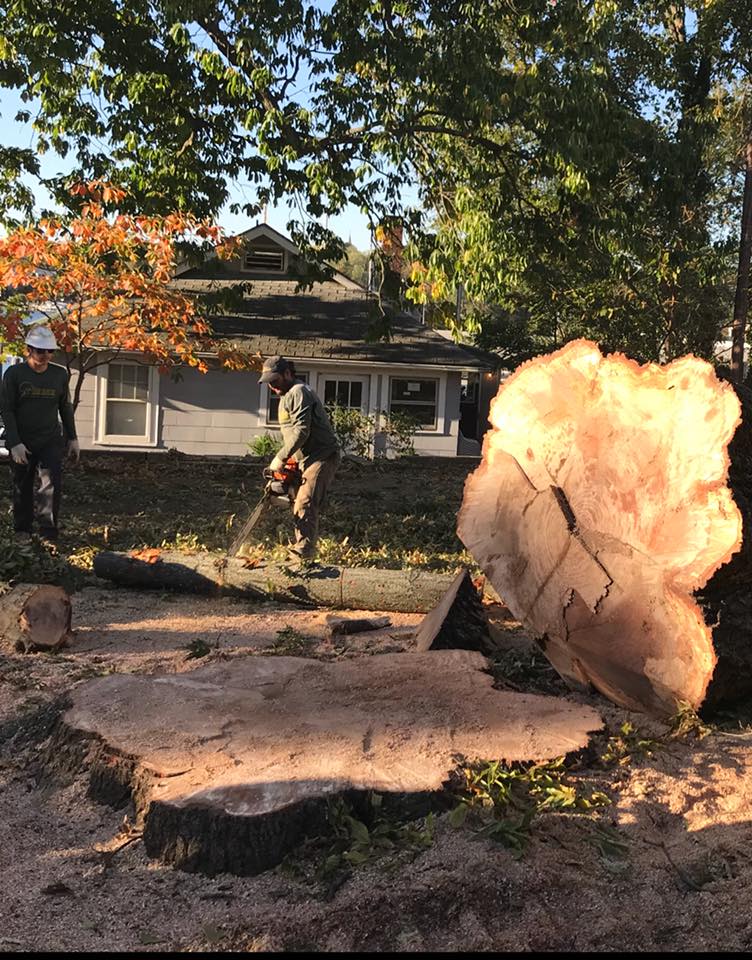
A tree’s living tissue sits near the outside of the trunk, which is why many hollow trees still leaf out every spring. The problem is strength, not survival. Once about a third of the interior is hollow or rotten, removal is generally the safer call.
Watch for:
Vertical cracks or seams, open cavities, soft or crumbling wood, and old wounds that haven’t closed.
3. Mushrooms, Conks, or Fungus on the Trunk or Base
Fungal growth is one of the clearest outward signs of decay you can’t see. Mushrooms, shelf-like conks, and brackets growing on the trunk or at the root collar usually mean rot is already well established inside the wood or roots.
Not every mushroom is a problem
Mushrooms popping up in the lawn after a rainy week are often harmless and simply feeding on buried organic matter.
The concern is fungus attached to the tree itself, or a ring of fruiting bodies right at the base.
Root decay is especially serious because it attacks the anchor. When a tree with a full, green canopy topples on a calm day, decayed roots are a common cause.
Watch for:
Conks or brackets on the bark, mushrooms clustered at the base, spongy wood, and sawdust-like debris around the root collar.
4. A Sudden Lean or Heaving Soil
Plenty of trees grow with a gentle, stable lean toward the light. A new lean is a different story. It usually means roots have broken or the soil holding them has given way.
It is suggested that a tree leaning more than about 15 degrees from vertical should probably be removed, and that a sudden lean calls for immediate attention.
Check the ground on the opposite side
Soil that’s cracking, mounding, or lifting on the side away from the lean is a sign the root plate is pulling out of the ground. A tree in that condition can come down with little warning, particularly in saturated soil or high wind.
Watch for:
A lean that’s new or getting worse, cracked or raised soil at the base, and exposed or snapped roots.
5. Root Damage From Construction, Grading, or Erosion
Many homeowners who ask “when should you remove a tree” are dealing with problems that have nothing to do with storms. The trouble often traces back to work done near the tree months or even years earlier.
Common causes of root damage on Maryland properties
- Excavation for additions, foundations, or pools
- Trenching for utilities or irrigation
- Driveways and patios built over the root zone
- Soil compaction from heavy equipment
- Fill soil piled over existing roots
- Shoreline erosion on waterfront lots
Damage to roughly half the root system is often enough to justify removal. Raising the grade is a quieter threat: according to UMD Extension, three inches or more of soil piled over a tree’s roots can be enough to kill it.
Trees spared during construction often decline three to five years later, once compaction, grade changes, and sudden sun exposure catch up with them.
Watch for:
Thinning canopy after nearby construction, sprouts coming from the base or along the trunk (a classic stress response), and roots that were cut, paved over, or buried.
6. Pest-Killed or High-Risk Species
Some trees are harder to save because of what’s attacking them, or because of what they are.
Dead ash trees should not wait
Ash trees killed by emerald ash borer become brittle as the borers destroy the wood. Limbs can snap unpredictably, which makes these trees difficult and dangerous to remove even for experienced crews. We recommend having dead ash trees removed by a professional as soon as possible.
Weak-wooded and invasive species
Species like Callery (Bradford) pear, Norway maple, box elder, Siberian elm, tree of heaven, and many willows and poplars are known for weak wood, frequent limb breakage, or aggressive spread. A struggling tree of one of these species is usually a stronger candidate for removal than a struggling oak.
Watch for:
D-shaped exit holes or bark splitting on ash trees, repeated limb drop, and invasive species crowding out healthier trees nearby.
7. The Tree Is in the Wrong Place
A healthy tree can still be the wrong tree for its spot. Location turns ordinary defects into real hazards. When the tree stands near a house, location is often what decides when you should remove a tree.
Too close to the house
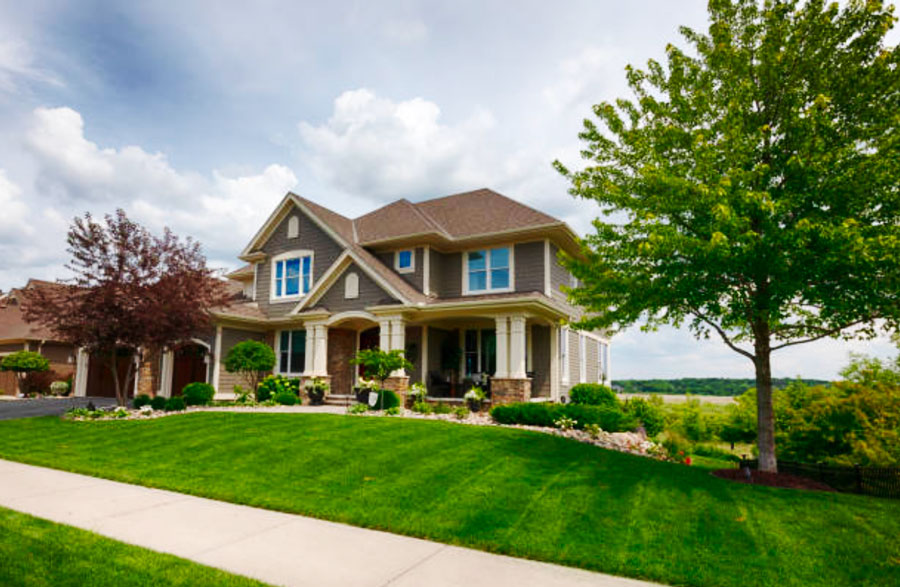
As a general guideline, large trees should be at least 20 feet from a home, and branches shouldn’t hang over the roof. Trees closer than that can damage foundations, gutters, and roofing, and they leave very little margin if a limb fails.
Growing into power lines
Trees under power lines should mature below about 25 feet. During wet weather, electricity can arc to wet foliage, causing outages or worse. Work anywhere near energized lines is never a homeowner job, and some situations require coordination with the utility.
Tight spaces and difficult access
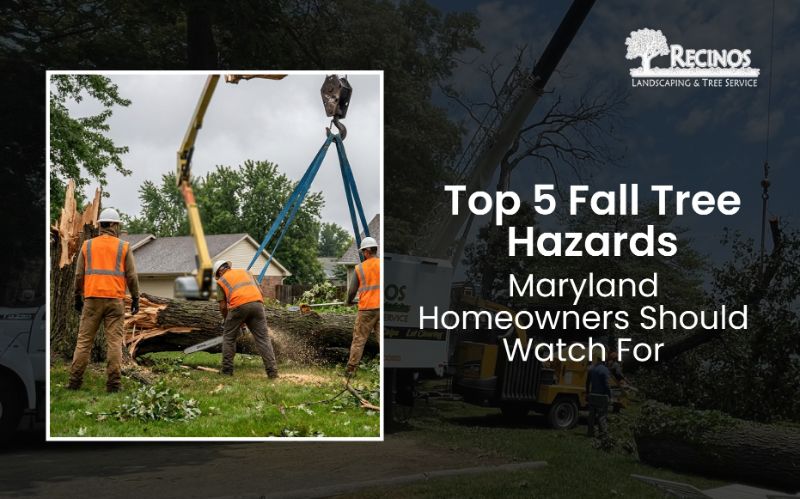
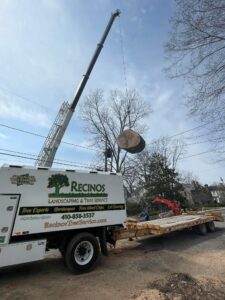
Trees wedged between houses, over pools, or above a shoreline are the hardest to take down safely. For these situations, crane-assisted tree removal lets the crew lift sections out in a controlled way rather than lowering them onto what you’re trying to protect.
Watch for:
Limbs over the roof, trees within about 20 feet of the house, contact with utility lines, and trees positioned to strike a structure if they fail.
When Should You Remove a Tree in Maryland? Timing by Season
Once you’ve decided a tree needs to come down, timing matters. It affects access, lawn damage, scheduling, and wildlife.
Hazardous trees: right away, any season
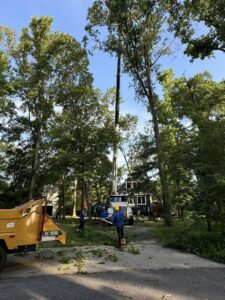
If a tree is dead, cracked, leaning toward your home, or damaged by a storm, it can be a sign of danger, call a professional tree removal service. A tree that already threatens a structure, driveway, or power line should be handled as soon as a qualified crew can get there safely.
Planned removals: late fall through early spring
For trees that aren’t an immediate danger, the dormant season is usually the most practical window in Maryland.
- Bare branches make the tree’s structure and any defects easier to see.
- Firmer or frozen ground supports equipment and reduces ruts in the lawn.
- Dormant plants around the tree are less likely to be damaged.
- Nesting season hasn’t started, so there’s less chance of disturbing birds.
Spring and summer removals
Removals happen year-round, but spring often brings soft, wet ground and active nesting, and summer heat adds stress to surrounding landscaping. A good crew will plan around these conditions rather than avoid them entirely.
Permits and Approvals Before Tree Removal in Maryland
Many single-tree removals on private residential lots don’t require a permit, but several common situations do. Check before work begins.
Waterfront and Critical Area properties
Maryland’s Critical Area includes all land within 1,000 feet of tidal waters and tidal wetlands. Closest to the water is the Buffer, a strip at least 100 feet wide where the rules are strictest.
- Outside the Buffer, homeowners can generally get local approval to remove trees, usually with replacement planting.
- Inside the Buffer, trees generally can’t be removed unless they’re dead, dying, diseased, or hazardous, and removal requires an approved Buffer Management Plan.
- For hazardous or storm-damaged trees in the Buffer, a Simplified Buffer Management Plan typically applies, and each tree removed is usually replaced with nursery stock. Dead trees typically don’t require replacement, but the area must be stabilized with native vegetation.
Removing healthy trees in the Buffer just to open a water view isn’t permitted, though careful pruning may be.
Roadside trees
Planting, pruning, or removing a tree in any road right-of-way in Maryland requires a Roadside Tree Project Permit from the Maryland DNR Forest Service, and some counties add their own permit on top of it.
HOAs, towns, and neighbors
Homeowners associations and incorporated towns may have their own rules. And if the tree sits on or near a property line, confirm ownership first. In Maryland, cutting down a neighbor’s tree without permission can expose you to liability of up to three times the value of the timber.
This is general information, not legal advice. Requirements vary by county and municipality, so confirm with your local planning office before removal.
Replanting After Removal: Should You Remove the Burlap When Planting a Tree?
Taking a tree down often opens room for a better-suited replacement, and on Critical Area properties replanting may be required. One question comes up constantly at that stage: should you remove the burlap when planting a tree?
The short answer is yes, at least most of it. Here’s how it works with a balled-and-burlapped (B&B) tree.
How to handle burlap, twine, and wire baskets
1. Set the tree first
Dig the hole two to three times as wide as the root ball, but no deeper, so the root flare sits at or slightly above grade. Lower the tree into place before cutting anything, so the root ball stays intact.
2. Remove all twine and rope
Cut every piece away from the trunk and root ball. Twine left around the trunk can girdle the tree as it grows.
3. Cut back the wire basket
Clip away at least the top portion of the basket so roots aren’t constricted near the surface.
4. Pull back and cut away the burlap
Remove the burlap from at least the top third to half of the root ball. Natural burlap left at the bottom of the hole will break down over time.
5. Remove synthetic burlap completely
Plastic, vinyl, or treated burlap doesn’t decompose and can strangle roots, so it needs to come off entirely.
If you can’t tell whether the wrap is natural or synthetic, treat it as synthetic and remove it.
So, should you remove burlap when planting a tree you bought from a nursery?
Yes. Even natural burlap can break down slowly in heavy or wet soil, and any burlap exposed above ground can wick moisture away from the root ball. Removing as much as you safely can, without breaking the root ball apart, gives the new tree its best start.
Our mulch and plant installation team can handle replacement plantings, and stump grinding clears the old site so new roots have room to grow.
Why You Shouldn’t DIY a Tree Removal
Tree removal is one of the most dangerous jobs a homeowner can attempt. Trunks and limbs carry hidden tension, decayed wood fails unpredictably, and a misjudged cut can send a section into a roof or a person.
It’s also a licensing issue. In Maryland, anyone paid to work on, evaluate, or advise on trees must be a Licensed Tree Expert through the Maryland DNR Forest Service, which also requires insurance and a written contract with each client.
Questions to ask before you hire
- Can I see your Maryland Licensed Tree Expert number?
- Do you carry liability and workers’ compensation insurance?
- Will I get a written estimate that covers cleanup, stump work, and debris removal?
- How will you protect my lawn, hardscape, and nearby structures?
- Who handles permits or Buffer Management Plans if they’re needed?
Be cautious with anyone who knocks on your door after a storm offering a quick, cheap removal with only a cell phone number to reach them.
When to Call a Professional Tree Removal Service
Reach out to a professional tree removal service when you notice:
- A sudden lean or soil lifting at the base
- Conks, mushrooms, or open cavities on a tree near your home
- Large dead limbs or a broken top over a roof, driveway, or play area
- A dead or dying ash tree anywhere on the property
- Branches growing into utility lines
- Storm damage on a waterfront or Critical Area lot
If you’re weighing several trees at once or clearing an overgrown section of property, lot clearing can handle the work in one visit.
Tree Removal Company in Maryland
Recinos Landscaping & Tree Service is a family-owned company providing professional tree services for residential and commercial properties across Maryland. Our work is overseen by a Maryland Licensed Tree Expert, and we specialize in hazardous, waterfront, critical-area, and tight-access removals with controlled methods, honest recommendations, and complete cleanup. Since 2010, we’ve served Annapolis, Arnold, Edgewater, Severna Park, and surrounding communities throughout Anne Arundel County and the Eastern Shore.
Call 410-858-3537 or request a free estimate to have a tree evaluated. Every property is different, so an on-site evaluation comes first.
Frequently Asked Questions About When to Remove a Tree
When should you remove a tree?
You should remove a tree when it’s dead, when roughly half or more of it is damaged, when a third or more of the trunk is hollow, when it develops a sudden lean, or when it’s positioned to strike a home or power line if it fails. Trees with lighter damage can often be saved with pruning or cabling. If the tree is an immediate hazard, remove it right away regardless of season. Otherwise, late fall through early spring is usually the most practical window in Maryland.
Should you remove the burlap when planting a tree?
Yes, as much as you can without damaging the root ball. Set the tree in the hole first. Then remove all twine, cut back the top of any wire basket, and cut away the burlap from at least the top third to half of the root ball. Natural burlap left underneath will decompose, but synthetic or treated burlap must be removed completely because it won’t break down and can restrict root growth.
What is the best month to remove a tree in Maryland?
For planned removals, late fall through early spring, roughly November through early March, is usually the most practical window. Trees are dormant, branches are bare, and firmer ground helps protect your lawn from equipment. Dead, damaged, or hazardous trees should be removed as soon as possible in any month.
Do I need a permit to remove a tree on my property in Maryland?
Often not, but it depends on location. Properties within 1,000 feet of tidal water fall under Maryland’s Critical Area rules, and trees in the 100-foot Buffer generally require an approved Buffer Management Plan before removal. Roadside trees require a state permit, and some counties, towns, and HOAs have their own requirements. Check with your local planning office before work begins.
Can a dying tree be saved?
Sometimes. Trees with less than about 25% branch damage, minor trunk wounds, or stress from a recent drought often recover with proper pruning, mulching, and watering. Trees with advanced root decay, major trunk hollowing, or extensive dieback usually can’t be restored to a safe condition. An on-site evaluation is the most reliable way to tell the difference.
Is it better to remove a dead tree or let it stand?
It depends on where it stands. Dead trees in natural areas, well away from homes, paths, and power lines, can be left as wildlife habitat. Dead trees near structures, driveways, or anywhere people gather should be removed, because dead wood becomes more brittle and unpredictable over time.