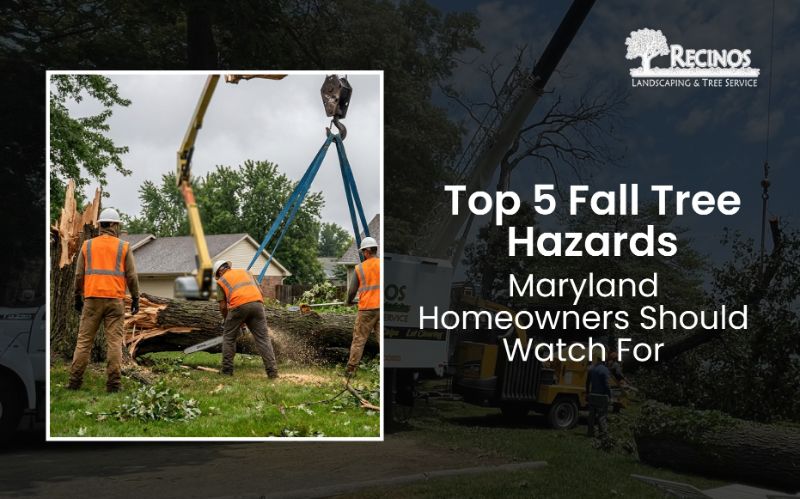
Autumn puts Maryland trees under real stress. A calm, practical guide to the tree hazards worth watching for this fall, how to assess tree hazards on your property, and when it’s time to call a professional.
Risks of Tree Hazards in Maryland
Fall is one of the harder seasons on Maryland trees. Wind and sunlight reach deeper into the canopy and down to the forest floor, drying out brush and debris. The relative humidity of the air falls, and gusty autumn weather moves in.
Wildfires in the state peak in spring and fall for exactly these reasons, with the changing foliage adding to the risk of fires spreading through brush and forest.
The same winds that raise fire risk also test the structure of every tree on your property. A tree weakened by decay, root damage, or an old wound may stand quietly through the summer and then fail when the first strong storm arrives.
That’s why fall is the right time to walk your property and look closely at the trees near your home, driveway, and power lines.
Recognizing tree hazards early is the surest way to prevent damage before it happens.
1. Dead and Hanging Branches (Widowmakers)
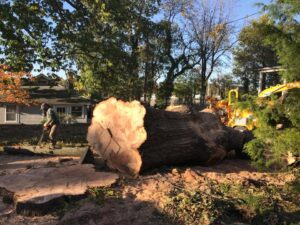
Large dead limbs and broken branches hung up in the canopy are among the most dangerous tree hazards, and fall wind brings many of them down. Because a hanging branch can drop without warning, arborists sometimes call these “widowmakers”.
Dead tree hazards aren’t limited to whole trees
A single heavy limb over a roof, driveway, or play area is enough to cause serious injury or damage.
Trees that have already lost their tops, dropped large limbs, or show dead branches all on one side deserve a closer look, since one-sided dieback can signal root or trunk damage on the affected side.
Removing limbs near power lines or over structures is dangerous
The safest response is an on-site evaluation and, where needed, professional tree trimming or removal by a crew with the right equipment.
Watch for:
Large dead limbs, broken branches caught in the canopy, and dead branches concentrated on one side of the tree.
2. Trunk Cracks, Cavities, and Old Wounds
The trunk carries the whole tree, so damage there is a serious concern. Vertical cracks, deep seams, dead branch stubs, and large older wounds all suggest internal decay that isn’t always visible from the outside.
A useful guideline: severe damage to the main trunk often warrants removal, while a wound covering less than about a quarter of the trunk’s circumference may gradually heal over.
Hollow trunks are trickier
Many trees live for years with a hollow center because the living tissue is near the outer edge, but once roughly a third of the interior is hollow or rotten, the tree’s strength is compromised enough that removal is usually the safer call.
Assess internal decay
Assessing internal decay is one of the harder tree hazards to judge from the ground, which is exactly where an experienced eye helps. If a trunk shows cracks, cavities, or soft, punky wood, have it evaluated before the next storm.
Watch for:
Vertical cracks or seams, open cavities, soft or crumbling wood, and large old wounds on the main stem.
3. Fungal Decay at the Base and on the Trunk
Mushrooms, conks, and shelf-like brackets growing on the bark, the trunk, or the ground at the base of a tree are one of the clearest warning signs of trouble.
These fruiting bodies as especially important to look for, because they usually mean the internal decay is already advanced and the tree’s stability may be compromised.
Root decay
Not every mushroom near a tree signals disease, and fall is when many fungi naturally appear, particularly after a hard rain.
But fungi growing on the tree itself, rather than in the surrounding soil, point to internal rot and should be evaluated by a professional. Root decay is especially troublesome: when a whole tree topples without an obvious reason, decay in the roots is a common culprit.
Watch for:
Mushrooms, conks, or brackets on the trunk or at the base; soft or spongy bark; and sawdust-like debris around the root collar.
4. Leaning Trees and Root or Soil Problems
A tree that leans is more of a hazard than one growing straight, and a sudden lean is a warning that demands immediate attention.
When a tree begins to tip, look at the ground on the opposite side of the lean.
Soil that is heaving, cracking, or lifting is a sign the root system is failing, and a tree in that condition can come down quickly.
Root problems that are common on Maryland properties:
- Recent construction
- Trenching for utilities
- Driveways paved over the root zone
- Soil compaction from equipment
- Erosion near the water
Damage to roughly half the root system is often enough that removal becomes the safer choice. A tree leaning more than about 15 degrees from vertical generally should be removed as well.
Leaning trees near a home, driveway, or shoreline are worth a prompt professional assessment, since the equipment and approach for taking them down safely depend heavily on which way they’re loaded and how much room there is to work.
Watch for:
A new or worsening lean, cracked or heaving soil at the base, and exposed or broken roots.
5. Trees Near Power Lines, Structures, and Tight Spaces
The final hazard is less about the tree’s health and more about where it stands. A structurally sound tree can still be a serious hazard if it’s positioned to strike a house, a vehicle, a fence, or a power line when it fails.
During wet weather, electricity can even arc several feet from a line to wet foliage, causing outages or worse.
Trees in tight spots, over structures, or near utility lines are the hardest and most dangerous to remove, and they’re a large part of why professional equipment matters.
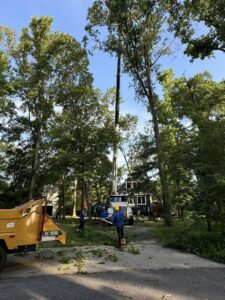
This is where crane-assisted tree removal is often the safest approach, lifting large sections out cleanly rather than dropping them near what you’re trying to protect. For waterfront and environmentally sensitive lots, critical-area tree removal uses controlled methods that protect the shoreline and surrounding landscape.
Removing trees anywhere near power lines is never a homeowner job
The cost of an accidental contact with a live line is simply too high, so these dangerous jobs should always go to a professional tree removal service.
Watch for:
Trees overhanging the roof, growing into or under power lines, or positioned where a fall would hit a structure.
How to Assess Tree Hazards on Your Property This Fall
You don’t need to be an expert to do a first pass. Walking your property a few times a year, and especially before winter storm season, helps you catch problems early.
When homeowners ask “how to assess tree hazards on my property”, it comes down to a simple, repeatable look:
- Start at the top and look for dead limbs, broken branches caught in the canopy, and thinning or one-sided crowns.
- Check each trunk for cracks, cavities, soft wood, and old wounds.
- Look at the base and root zone for mushrooms or conks, heaving soil, and exposed roots.
- Note any tree that leans, especially a new lean, and any tree positioned over a structure or near power lines.
- Pay special attention to trees killed by pests such as emerald ash borer, whose wood becomes brittle and unpredictable to work with.
What to Do If You Identify Tree Hazards
If you find a tree with several signs, or even one serious sign near your home, the next step is an on-site evaluation.
Some tree hazards, like internal decay and unhealthy roots, are difficult to detect from the ground, which is why a professional assessment matters before you decide on removal.
Where clearing a group of trees is the goal, lot clearing can restore a property safely, and stump grinding finishes the job by removing what’s left below the surface.
Most tree pruning and removal work is not safe for the average homeowner. When a tree looks questionable, the practical move is to bring in a professional rather than take a risk with a chainsaw and a ladder.
When to Call a Professional Tree Service
Some situations call for prompt professional help rather than a wait-and-see approach. Reach out to a tree service near you when you notice:
- A tree or large limb that has already fallen, or a branch hung up in the canopy
- A sudden lean or visibly heaving soil at the base
- Fungal conks or advanced decay on a tree near your home
- Any hazardous tree over a structure, driveway, or power line
- Storm damage that needs a fast, safe response
For trees that have already come down or pose an immediate threat, emergency tree service gets a trained crew on-site to stabilize the situation and remove the hazard safely. Recinos accepts emergency calls anytime.
Tree Service Company in Maryland
Recinos Landscaping & Tree Service provides professional tree services for residential and commercial properties across Maryland, safely removing hazardous trees with professional equipment, controlled methods, honest recommendations, and thorough cleanup. Since 2010, we’ve served Annapolis, Arnold, Edgewater, Severna Park, and surrounding communities throughout Anne Arundel County and the Eastern Shore.
Call 410-858-3537 or request a free estimate to have a hazardous tree evaluated. Every property is different, so an on-site evaluation comes first.
Frequently Asked Questions About Fall Tree Hazards
Who is responsible when a neighbor’s tree falls in your yard in Maryland?
In most cases, when a healthy tree falls due to a storm or high winds, Maryland treats it as an “act of God,” and the owner of the property where the tree lands handles the cleanup, typically through their own homeowner’s insurance. There’s an important exception: if the tree was dead, diseased, or clearly hazardous, and your neighbor knew or should have known and did nothing, they may be liable for the damage. If you’re worried about a neighbor’s tree, a written statement from a Licensed Tree Expert documenting its condition, delivered to your neighbor, can establish a record before anything falls. This is general information, not legal advice; consult an attorney for your specific situation.
What are the dangers of a fallen tree?
A fallen or falling tree can cause serious injury, damage roofs, vehicles, fences, and utility lines, and knock out power. Downed limbs tangled with power lines are especially dangerous because of the risk of live wires and electrical arcing. Even after a tree is down, hidden tension in the trunk and limbs can cause sudden, unpredictable movement when cut, which is a major reason removal is best left to a trained crew.
Who is liable if a tree falls down?
Liability in Maryland turns on negligence. If the tree was healthy and fell in a storm, it’s generally considered an act of God with no fault assigned, and each property owner bears the cost on their own land. If the tree was known to be hazardous and the owner failed to act, that owner can be held liable. Insurance coverage is a separate question from legal liability and depends on the specific terms of your policy. Because these disputes hinge on what someone “knew or should have known,” documentation matters.
What is the tree law in Maryland?
Maryland follows what’s often called the “Massachusetts Rule,” established in the Melnick case. Under it, if a neighbor’s tree, branches, or roots encroach onto your property, your remedy is self-help: you may trim branches and roots back to the property line at your own expense. You generally cannot force your neighbor to remove the tree, enter their property without permission, or recover damages for the encroachment alone. Liability for a falling tree is handled separately, under ordinary negligence rules described above.
Can I force a neighbor to cut down a tree?
Generally, no. Under Maryland’s approach, you can’t compel a neighbor to remove a healthy tree, even if its branches or roots cross onto your land. Your right is to cut back the encroaching growth to the property line yourself. The picture changes only if the tree is genuinely hazardous and your neighbor has been made aware of the danger, at which point negligence and liability come into play. Trees that sit exactly on a boundary line are treated as shared, and neither owner may remove or heavily trim one without the other’s consent.
How to tell if a tree is a hazard?
Look for the warning signs covered in this article: large dead or hanging branches, cracks and cavities in the trunk, mushrooms or conks at the base, a new or worsening lean with heaving soil, and any tree positioned to strike a home or power line if it fails. Some hazards, such as internal decay and root damage, are hard to see from the ground. If a tree shows several of these signs, or one serious sign near a structure, have it evaluated by a professional before deciding on removal.